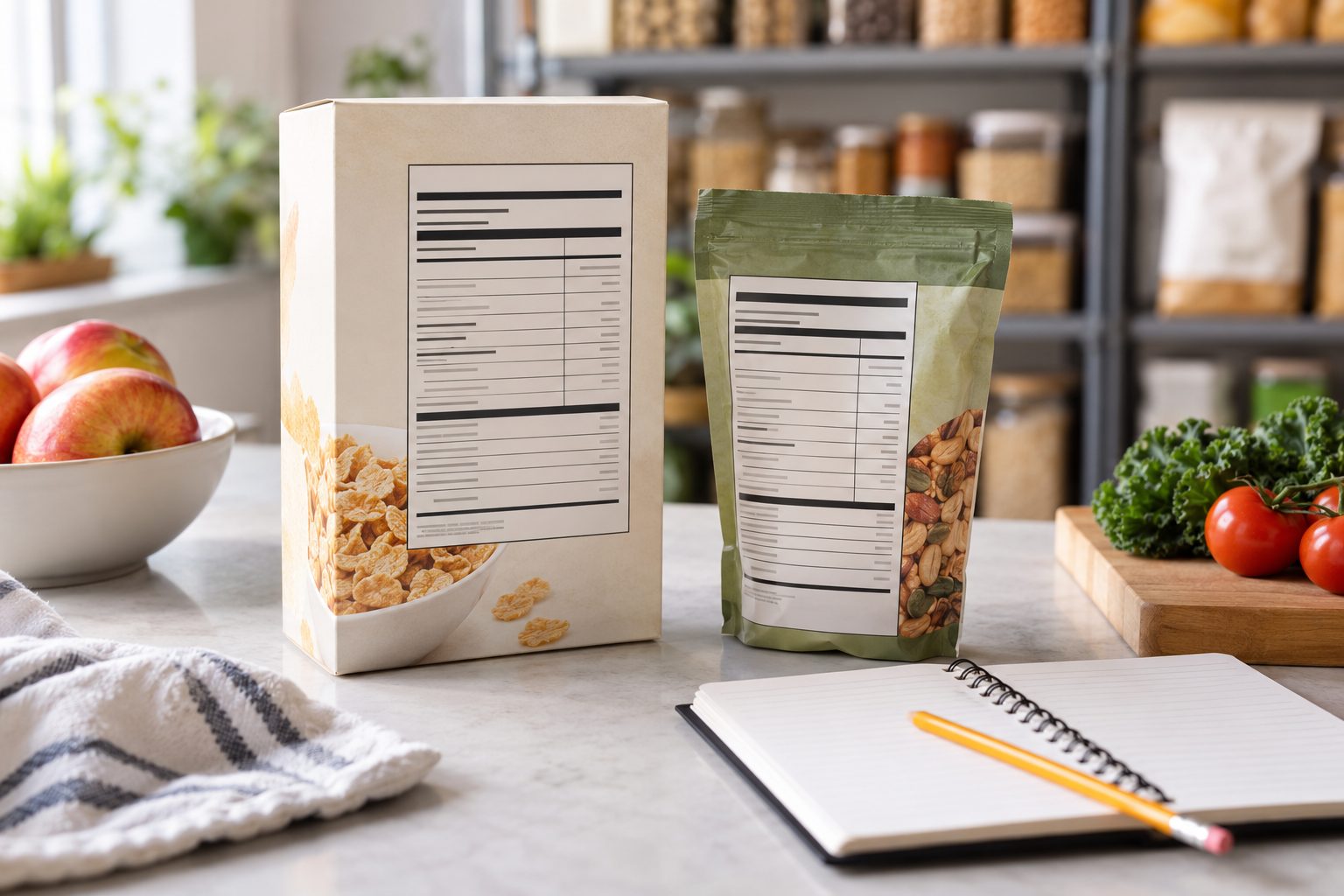
Two packages sit beside each other on the shelf. One announces a benefit in large letters. The other looks plain, costs less, and has a similar ingredient list. You turn them over, see several rows of numbers, and wonder which information should decide the purchase.
Learning how to read food labels becomes easier when you begin with a question. You are choosing a food for a particular purpose, within a real budget. The label helps answer part of that decision. This article gives you a way to practice with two products and leave the comparison with a useful conclusion.
Decide what you are comparing
Pick two foods that you would use in roughly the same way. Comparing two breakfast cereals is usually more meaningful than comparing cereal with cooking oil. The products have a similar job in your kitchen, so the question is easier to define.
Before looking at the numbers, say what matters to you. Perhaps you want a cereal with more fiber, a soup with less sodium, or a yogurt with less added sugar. If you have individualized nutrition advice, use that advice to choose your question. There is no need to invent a priority just because a package emphasizes one.
Keep your practical requirements visible too. A food may need to fit an allergy restriction, a storage space, or a spending limit. You can write those requirements down before shopping. That helps prevent a prominent claim from distracting you from something essential to your actual purchase.
Start with the amount behind the numbers
Nutrition Facts information is generally shown per listed serving. Serving sizes can differ, and a package can contain more than one serving. The FDA explains that a serving size describes an amount people typically consume; it is not a recommended portion for you. [1]
Imagine a hypothetical cereal with 4 grams of fiber per 40-gram serving and another with 3 grams per 30-gram serving. At 60 grams, each would provide 6 grams of fiber. The first number looked larger, but the amount of cereal behind it was larger too.
You do not have to perform calculations on every shopping trip. This example simply shows why the serving deserves a glance before you compare. When the amounts match, the comparison is more straightforward. When they differ, you can slow down and decide whether a calculation would change your choice.
Understand what a percentage can tell you
The percent Daily Value shows how a serving contributes to a reference daily amount. FDA guidance describes 5% Daily Value or less as low and 20% or more as high for a nutrient. These reference values are tools for comparison, rather than a personalized nutrition prescription. [1]
Use that information in relation to your question. If you are comparing sodium, look at sodium. If you are comparing fiber, look at fiber. A high percentage does not mean the same thing for every nutrient or every person's needs, so avoid treating the percentage as a universal product score.
Next, look back at how you use the food. A sauce eaten in a small amount has a different role from the main component of a meal. You are trying to understand the food within your pattern of eating. That context can matter more than which package has the most impressive front label.
Separate total sugar from added sugar
Total sugars include naturally occurring sugars and any added sugars. The added sugars line identifies the portion counted as added, including sugars from ingredients such as honey and syrups. You do not add that number to total sugars again. [2]
For a hypothetical example, a label might list 12 grams of total sugars, including 5 grams of added sugars. The total remains 12 grams. Reading the word “including” correctly prevents you from accidentally counting the added amount twice.
If you want to explore that comparison in more detail, read how to reduce added sugar while keeping foods you enjoy. For this exercise, it is enough to understand which line answers your question. You can build your label-reading skills one distinction at a time.
Bring price and preference back into the decision
Now imagine that the product with your preferred nutrient profile costs considerably more. Would you use it regularly? Would another food already in your basket serve the purpose you had in mind? These questions belong in the comparison alongside the numbers.
You might choose the less expensive product and plan the rest of the meal accordingly. You might decide that the difference matters enough to pay for it. Either conclusion can be thoughtful if you understand your reason. A useful comparison ends with a decision you can explain in ordinary language.
Enjoyment deserves the same attention. Buying something you consistently dislike creates a separate problem. If you want to try a new option, consider the smallest practical purchase. That lets you learn whether the taste and texture suit you before committing more of your budget.
Practice once at home
Take two packages you already own and place them side by side. Read the serving amounts, choose one nutrient, and compare it on an equivalent basis. Then write a sentence explaining the result. For example: “These are similar for the nutrient I checked, so price will decide my next purchase.”
Notice what remains unanswered. A label cannot tell you whether a soup will taste good to you or whether the package will be easy to open. Your own experience supplies those details. Keeping the two kinds of information together makes the next decision more useful.
On your next shop, choose one pair of comparable foods and ask one clear question. Read the serving amount first, compare the information that answers your question, and finish with a choice that fits your kitchen and budget.
Sources
- [1] U.S. Food and Drug Administration. How to Understand and Use the Nutrition Facts Label. Accessed November 1, 2026.
- [2] U.S. Food and Drug Administration. Added Sugars on the Nutrition Facts Label. Accessed November 1, 2026.