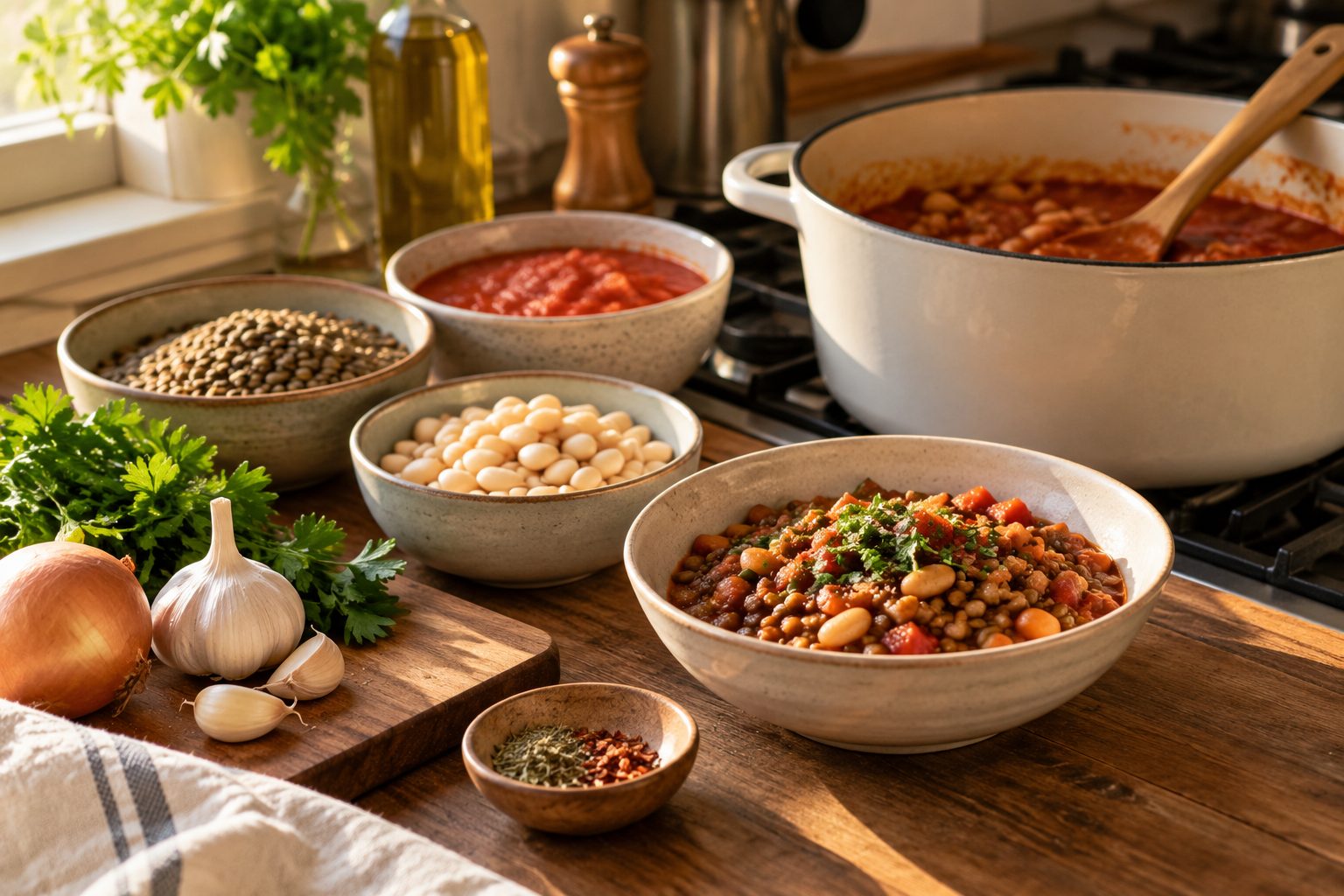
A bag of lentils or a tin of beans can seem full of possibility until you have to decide what to cook. You may know they belong in many familiar dishes, but the recipes you find ask for ingredients you rarely use. The food stays in the cupboard while dinner takes another direction.
Starting with beans and lentils becomes easier when you give them one specific job. You can choose a convenient form, connect it with a meal you know, and learn from the result. There is no need to begin with a large batch or an unfamiliar cooking project.
Decide what you want to learn first
There are several different skills hidden inside the phrase “cook more beans.” You might need to learn how to prepare dried beans safely, how to season ready-cooked beans, or how to include lentils in a meal. Choose one skill so your first attempt stays manageable.
If your main question concerns flavor, a ready-cooked product may let you focus on that question. If you want to learn preparation from dry, follow a reliable recipe and the package instructions for the particular food. Different products require different handling, so avoid assuming that one method applies to everything.
Think about the equipment you have and the time you are willing to spend. A plan that needs equipment you do not own is still only an idea. Choose an approach that can happen in your actual kitchen, then expand your skills if you enjoy the result.
Understand why a small beginning makes sense
Beans and lentils are among the foods NIDDK lists as sources of fiber. Its guidance advises increasing fiber gradually. [1] If they are unfamiliar in your diet, that supports beginning with a modest change rather than redesigning every meal around them.
A small beginning is useful for cooking, too. You can find out whether you like a particular texture and seasoning before preparing more. Follow any individual dietary advice you have, especially if you have been told to limit or adjust fiber.
For this exercise, choose one type of bean or lentil and one meal. You are learning how those two things work together. Another variety may behave differently in a recipe, so leave that comparison for a later attempt if you want to explore it.
Give a familiar meal one new component
Imagine that you already make a tomato-based pasta sauce. You could add a little prepared lentil to one portion and taste the result. The sauce gives you a familiar setting, while the lentils give you one feature to examine.
Alternatively, suppose you often make a rice bowl. You could try ready-cooked beans with the seasoning you usually enjoy, following their preparation directions. Keep the other components familiar. Then ask whether you like the combination and whether the extra step feels worthwhile.
A third possibility is a sandwich filling made with a suitable cooked bean. You might prefer a chunky or smooth texture. Try a small amount before preparing a whole container. These examples are recipe directions to explore, not interchangeable nutrition prescriptions or complete meal plans.
Diagnose the cooking problem precisely
If the result is disappointing, describe why. “Bland” suggests looking at seasoning. “Too wet” suggests reviewing the recipe's liquid and preparation steps. “Wrong texture” may suggest a different variety or a different dish. Each description points toward a practical next attempt.
Avoid changing everything at once. If you switch the bean, sauce, preparation, and meal, you may enjoy the next version but learn little about what solved the original problem. Keeping one or two things familiar makes the experience easier to interpret.
You can also decide that a particular dish is not worth pursuing. Perhaps you prefer lentils in soup to lentils in pasta sauce. That preference is useful. Building a routine means finding places where foods fit, rather than requiring every ingredient to work in every meal.
Compare convenience with the full cost
When choosing between ready-cooked and dry products, consider more than the shelf price. Think about the amount you will use, the preparation required, storage, and whether you are likely to finish what you buy. The less expensive package is not automatically the more useful purchase for your situation.
You can make a simple comparison at home. Record the purchase price and the number of meals you actually made from it. Add a note about preparation effort. You do not need to attach a monetary value to every minute; just include the effort in your decision.
If a convenient product helps you make a meal you enjoy, that may be a reason to keep buying it. If you enjoy cooking from dry and can use the result, that may suit you better. Let the choice reflect your own kitchen rather than a rule about what a serious cook should do.
Save what worked in a useful form
Write down the type of bean or lentil, the preparation, and the seasoning you liked. Include any detail you might otherwise forget, such as whether you preferred a smoother texture. A short note can become a recipe you understand from experience.
Then give the ingredient a place on your next shopping list. Buy it for that particular meal, with storage and use planned according to the product's instructions. If you want to expand the habit gradually, explore adding fiber through familiar meals.
Choose one prepared bean or lentil, pair it with a meal you already enjoy, and make a modest first attempt. Keep the combination if it works, or use your observation to choose the next version.
Sources
- [1] National Institute of Diabetes and Digestive and Kidney Diseases. Eating, Diet, & Nutrition for Constipation. Accessed November 1, 2026.