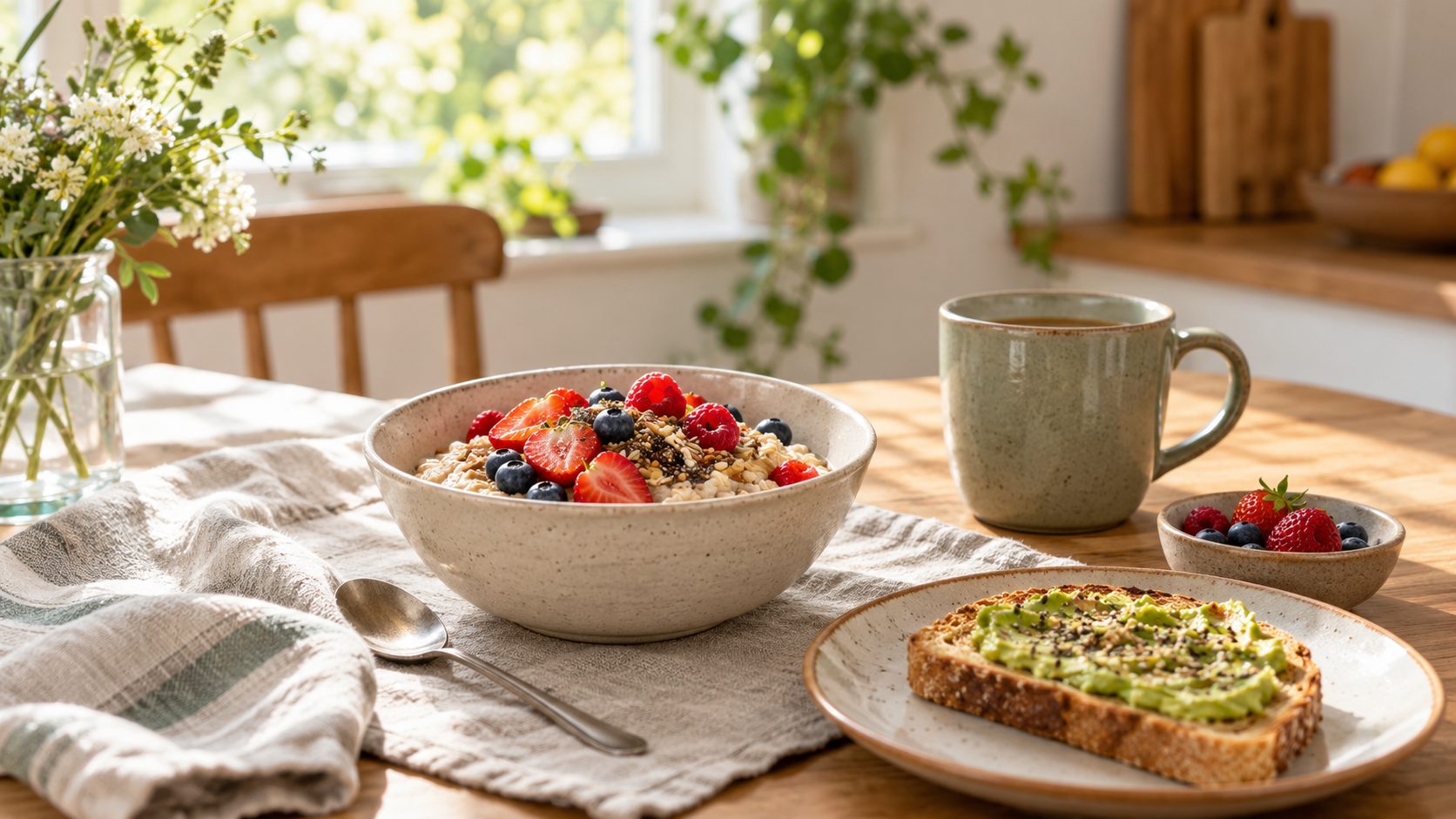
You can have a fridge full of breakfast ingredients and still leave the house wondering what to eat. Perhaps the recipe you saved needs a pan, a chopping board, and more attention than you have before work. Perhaps you keep buying something you think you ought to enjoy, then reach for something else.
Learning how to build a breakfast starts with a useful question: what would make this meal possible on an ordinary morning? You can explore that question without giving your whole routine a makeover. This article walks you through choosing a realistic starting point, assembling a meal, and deciding what to change after trying it.
Begin with the morning you actually have
Picture your last ordinary weekday. Where were you when you first had a chance to eat? What equipment could you use? Did you have somewhere to sit, or were you carrying food to work? Those details help you choose a breakfast you can actually make.
Write down one constraint in a sentence. “I have a kettle but no cooker at work” gives you something specific to solve. “I need to be healthier” leaves the practical problem unanswered. You might discover that your first task is finding a bowl with a lid, rather than choosing a new recipe.
Then consider what you enjoy in the morning. Warm or cold? Sweet or savory? Soft or crisp? A bowl of oats and a bean-filled tortilla are different starting points. There is room to choose familiar foods, including foods associated with lunch or dinner in someone else's household.
Give variety a practical meaning
The World Health Organization describes adequacy, balance, moderation, and diversity as foundations of a healthy diet. It also recognizes that the details depend on a person's circumstances and food culture. Breakfast can contribute to that overall pattern without having to accomplish everything by itself. [1]
For a planning exercise, choose a familiar starting food and ask what you would like alongside it. Toast might become toast with an egg and a piece of fruit. Oats might become oats with milk or a suitable alternative and berries. A savory breakfast might use rice, tofu, and vegetables you already enjoy.
These are meal ideas, not prescribed portions or nutritionally identical combinations. Use foods that suit your needs, allergies, and preferences. The useful skill is learning to assemble a meal from available ingredients, then adjusting the amount and combination to your own circumstances.
Make the easiest version first
Suppose you like the idea of oatmeal with several toppings. Before buying everything, imagine the least complicated version you would willingly eat. It might be plain oats with milk and a banana. You can add cinnamon or nuts later if you want them and can eat them safely.
This approach gives you a clearer experiment. If the simple version is inconvenient, extra ingredients are unlikely to solve the inconvenience. If it is convenient but dull, flavor is the next question. If you dislike the texture, a different breakfast may be more useful than another topping.
You can apply the same reasoning to savory food. Start with the sandwich you already know how to make. Consider whether you want something crunchy inside, something fresh alongside it, or a different filling. Change the part that matters to you instead of rebuilding the entire meal.
Compare packaged choices with a purpose
If breakfast includes packaged cereal or bread, start your comparison with the serving size. Nutrition Facts values generally refer to that listed amount, which may differ between products. The FDA explains that serving size reflects customary consumption and is not a recommendation for how much you should eat. [2]
Choose a question before you turn over the package. You might want to compare fiber in two cereals or added sugars in two yogurts. A focused question gives the numbers a purpose. You do not need to turn every breakfast purchase into an examination of every nutrient.
Price and enjoyment still belong in the decision. If one option costs more, ask whether you value the difference enough to buy it regularly. If a cereal suits your preferences and budget, you can also think about the rest of the meal rather than expecting that single product to meet every need.
Try it, then ask what you learned
Choose one breakfast for your next ordinary morning. Beforehand, make a small prediction: “Having the ingredients together will make this easier to prepare.” Afterward, note what actually happened. Did you have the right utensils? Was the portion convenient to carry? Did you enjoy eating it?
You can notice hunger and comfort without treating one morning as a scientific result. A different schedule or a rushed start may affect the experience. Your notes can guide a practical adjustment, but they cannot prove that a particular ingredient caused a change in energy or concentration.
If breakfast felt too complicated, remove a preparation step. If it was unappealing, change the flavor or temperature. If the amount did not suit you, reconsider the portion. Choose the next adjustment from the problem you observed. That is what makes the process a learning experience.
Keep a second option for a different morning
A breakfast that works at home may fail when you have an early appointment. Think of a second option that uses a different level of effort. It might be something you can assemble at work or buy nearby. Consider storage requirements and follow package instructions for foods you carry.
You do not need a perfect weekly rotation. Two workable choices can give you somewhere to begin, and you can expand them as you discover what you like. For another meal-building exercise, explore how to plan lunch around your workday.
For your next breakfast, choose one familiar food, decide what you want alongside it, and prepare the equipment you need. After eating, write one useful observation. Let that observation shape the next morning.
Sources
- [1] World Health Organization. Healthy diet. Updated January 26, 2026.
- [2] U.S. Food and Drug Administration. How to Understand and Use the Nutrition Facts Label. Accessed November 1, 2026.